Friday, 24 June 2011

Dino-Temp!

How do you take a dinosaur’s temperature? Scientists in the United States and Germany think they’ve achieved this once-impossible feat by analyzing the fossilized teeth of sauropods, the long-tailed, long-necked plant eaters that were the largest land-dwelling creatures in history. Using this innovative method, the team recently estimated that the extinct giants ran about as hot as humans, making them warm but not necessarily warm-blooded.
Camarasaurus
Skull reconstruction of Camarasaurus, which according to the study had a temperature of 96.3 degrees Fahrenheit. (Credit: Sauriermuseum Aathal, Switzerland)

“Originally, dinosaurs were considered to have been cold-blooded animals because they are reptiles, just like salamanders or crocodiles,” explained Thomas Tütken, a biochemist from the Steinmann Institut at the University of Bonn in Germany, who participated in the study. This assumption inspired the longstanding image of sluggish, lumbering beasts that tired easily and depended on the environment for heat.

In the last few decades, however, research on dinosaurs’ physiology has implied that they were much quicker, more nimble and more active than previously thought. (Picture the ferociously agile velociraptors of “Jurassic Park.”) Such behavior would require a fast metabolism, which in turn calls for a warm, well-regulated body temperature. Some studies have suggested that large dinosaurs accomplished this through thermal inertia, meaning they didn’t generate heat internally in the manner of modern mammals but still maintained a high body temperature thanks to their sheer size.

To test out the various hypotheses, the researchers measured the chemical composition of 11 teeth from the enormous herbivores Camarasaurus and Brachiosaurus, which roamed the planet some 150 million years ago. They detected how often the isotopes carbon-13 and oxygen-18 bonded together within the enamel, a phenomenon that occurs more frequently at lower temperatures. The amount of isotopic “clumping,” as it is known, indicated temperatures of 100.8 and 96.3 degrees Fahrenheit for Brachiosaurus and Camarasaurus, respectively.

“What we’re doing is special in that it’s thermodynamically-based,” said John Eiler, a geochemist at the California Institute of Technology and co-author of a paper published yesterday on the team’s methodology and findings in the journal Science Express. “Thermodynamics, like the laws of gravity, is independent of setting, time and context.”

Camarasaurus Skull
Closeup of a Camarasaurus skull and teeth. (Credit: Sauriermuseum Aathal, Switzerland)

While the study may have yielded the most accurate estimate for dinosaur temperatures to date, it also raised new questions, particularly about the thermal inertia theory’s validity. According to that model, these behemoths should have had temperatures of 104 degrees or higher, especially since they lived during the balmy Jurassic era. In the researchers’ view, this disparity could be explained by physiological and behavioral adaptations that allowed the dinosaurs to avoid overheating, such as lower metabolic rates or dispelling excess heat through their long necks and tails.

At the very least, the scientists’ findings provide strong evidence that large dinosaurs were not as cold as modern reptiles; they also open up new avenues of inquiry into how their bodies functioned. “The team has made important strides in discovering that the body temperature of dinosaurs was close to that of mammals, and that the dinosaurs’ physiology allowed them to regulate that temperature,” said Lisa Boush, program director in the National Science Foundation’s Division of Earth Sciences, which funded the study along with the German Research Foundation. “The result has implications for our understanding of dinosaurs’ ecology—and demise.”

Or, as evolutionary biologist and lead author Robert Eagle put it, “This is like being able to stick a thermometer in an animal that has been extinct for 150 million years.”

Source: History.com - http://www.history.com/news/2011/06/24/dino-temperature-puzzle-scientists-get-warmer/?cmpid=Social_Facebook_HistoryInTheHeadlines_06242011_3

Sunday, 12 June 2011

Lethal fungus adds to tornado woes in Joplin, Mo.

Eight people have been confirmed to have a rare but often deadly fungal infection after the Joplin tornado, and three have died.

Joplin tornado fungus

Volunteers help move a porch onto a debris pile in a tornado-stricken area of Joplin, Mo. Adding to the town's trouble is the outbreak of a fungus that likely contributed to the deaths of three people. The death count from the May 22 tornado reached 151. (T. Rob Brown, Joplin Globe / June 11, 2011)


Some survivors of last month's massive tornado that destroyed much of Joplin, Mo., are facing another indignity: an outbreak of a rare but frequently lethal fungal infection.

Eight people have been confirmed to have the infection, known as murcomycosis, and at least three of them have died, according to the Missouri Department of Health and Senior Services. Health authorities fear other tornado victims may also be infected without realizing it.
"People who have wounds that are not improving should seek medical attention immediately," said Dr. Benjamin Park, a medical officer in the mycotic disease branch of the Centers for Disease Control and Prevention in Atlanta, which monitors outbreaks of fungal infections.

Murcomycosis, traditionally known as zygomycosis, is a family of rare diseases caused by several different fungi that live in soil. The most common form occurs when fungal spores are inhaled. The organisms take root in the sinuses, then spread to the lungs and throughout the body. It typically strikes people with weakened immune systems, such as those with cancer or diabetes, or who are on immune-suppressing medications because they have had organ transplants.

The more unusual variant — which has been affecting residents of Joplin — is the cutaneous form, in which fungal spores get under the skin. Experts believe that the tornado's 200 mph winds blew contaminated dirt and debris directly into victims' skin, or that it got into open wounds caused by flying debris. Symptoms include redness or inflammation, swelling, tenderness or pain, heat in the area of the wound and fever.

Treatment for both types typically involves surgical removal of dead tissue and intravenous infusion of the antifungal medication amphotericin. An oral drug called posaconazole is also used.

The first cases were noticed by Dr. Uwe Schmidt, an infectious diseases specialist at Freeman Health System in Joplin. A week after the tornado, he and other doctors observed three patients in the intensive care unit with what looked like white, fluffy mold growing on the surface of some of their wounds. The infections continued to spread even though the doctors removed the diseased skin. But the infections slowed when amphotericin was administered.

Schmidt said he ultimately observed five cases at Freeman, out of 1,700 patients treated there after the May 22 twister.

"I was surprised," he said. "The so-called subcutaneous form of the fungus is not very common. I have never seen it myself before, and to suddenly see this cluster was quite striking."

He noted that all of the patients with the infections also suffered from severe wounds, so doctors cannot say with certainty that the three deaths were due to the fungus. "But it was probably a contributing factor in their demise," he said.

Pathologists at Freeman have confirmed the identity of the fungus in one case, and samples from all of the patients have been sent to CDC for further study.

Authorities emphasized that the infections do not spread from person to person, and that none of the cases was attributed to food, air, water or admission to a hospital.

Including the three patients whose deaths may have been related to fungal infections, a total of 151 deaths have now been linked to the tornado.
Prophase-State note:  The spelling of the infection is actually Mucormycosis, and was misspelled frequently in this article.  The article is posted in its entirety and unedited to remain true to our sources, as always, but this correction must be made.

thomas.maugh@latimes.com

Friday, 3 June 2011

Cryptic Mutations Could be Evolution's Hidden Fuel


The transformation of raw genetic material on a laboratory bench has provided a rare empirical demonstration of processes that may be universally crucial to evolution, but are only beginning to be understood.

The processes, called cryptic variation and preadaptation, involve mutations that don’t affect an organism when they first occur, and are initially exempt from pressures of natural selection. As they gather, however, at some later date, they could combine to form the basis for complex, unpredictable new traits.

In the new study, the ability of evolving, chemical-crunching molecules called ribozymes to adapt in new environments proved directly related to earlier accumulations of cryptic mutations. The details are esoteric, but their implications involve the very essence of adaptation and evolution.

“It’s one of the more modern topics in evolutionary theory,” said mathematical biologist Joshua Plotkin of the University of Pennsylvania, author of a commentary on the experiment, which was described June 2 in Nature. “The idea has been around for a while, but direct evidence hasn’t been found until recently.”

The experiment was led by evolutionary biologists Eric Hayden and Andreas Wagner of Switzerland’s University of Zurich, who use ribozymes — molecules made from RNA, a single-stranded form of genetic material – to study evolutionary principles in the simplest possible way.

The principles of cryptic variation and preadaptation were first proposed in the mid-20th century and conceptually refined in the mid-1970s. They were logical answers to the question of how complex traits, seemingly far too complex to be explained by one or a few mutations, could arise.

But even as such leading thinkers as Stephen Jay Gould embraced the concept, it proved difficult to study in detail. The tools didn’t exist to interpret genetic data with the necessary rigor. The concept itself was also difficult to grasp, injecting long periods of accumulation, purposeless mutations into an evolutionary narrative supposedly driven by constant selection.

In recent years, however, with the advent of better tools and a growing appreciation for evolution’s sheer complexity, researchers’ attention has turned again to cryptic variation and preadaptation. Computer models and scattered observations in bacteria and yeast hinted at their importance. But definitive proof, combining exhaustive genetic observation with real-world evolution, was elusive.
 
‘Cryptic variation addresses questions of innovation. How do new things come about in biology?’
“Cryptic variation addresses questions of innovation,” said Hayden. “How do new things come about in biology? There’s been a long history of this concept, but no concrete experimental demonstration.”
In the new study, Hayden and Wagner evolved ribozymes in test tubes of chemicals, then moved them to a new chemical substrate, a shift analogous to requiring animals to suddenly subsist on a new food source.
The ribozymes that flourished were those that had accumulated specific sets of cryptic mutations in their former environment. Those variations, seemingly irrelevant before, became the basis of newly useful adaptation. The researchers were able to measure every change in detail.

“It is a groundbreaking proof of principle,” said University of Arizona evolutionary biologist Joanna Masel, who wasn’t involved in the study. “This study is a clear demonstration that cryptic genetic variation can make evolution more effective.”

According to Plotkin, cryptic variation and preadaptation may be crucial to the evolution of drug resistance and immune system evasion in pathogens. Rather than looking for straightforward mutations, researchers could search for combinations, perhaps developing an “advance warning system” to flag seemingly innocuous changes.

Another application could be in genetic engineering. Whereas virus and bacteria designers tend to “accept any mutations that get them closer to their intended outcome,” said Plotkin, “it might be important to take lateral steps as well as uphill steps.”

Cryptic variation and preadaptation could also be important to the evolution of animals, from the origin of multicellularity to complex features like eyes and language. Plotkin would like to see studies revisiting the evolution of Charles Darwin’s famous finch beaks, but with an eye toward these newly described processes.
Masel said that better understanding cryptic variation and preadaptation could help programmers of evolving computer systems, and perhaps explain why some systems are better able than others to evolve. “Why are biological systems so evolvable?” she said. “This dynamic may or may not be the essence of evolvability. That’s certainly one of the hypotheses out there, and I am enthusiastic about it.”

These processes could also help interpret genomic studies that loosely link hundreds or thousands of genetic mutations to disease and development, frustrating geneticists searching for genetic patterns of heritability, said Masel and Hayden. And at a social level, they could be instructive to people interested in fostering innovation.
“My prediction is that it is good to foster lots of variation,” said Masel, who likened cryptic variation and preadaptation to Google’s famous requirement that employees spend 20 percent of their time on projects of personal whimsy. Rather than focusing narrowly on ideas that are obviously good, “Foster circumstances where lots of non-terrible ideas are floating around,” said Masel.

Image: A visualization of a ribozyme. (University of California, Santa Barbara)

Wednesday, 1 June 2011

Cup of Joe?

Analysis by Marianne English Tue May 31, 2011 01:13 PM ET
Caffeine molecular structure
Humans aren't the only life-forms that rely on caffeine to get them through the morning.

Researchers at the University of Iowa found a species of bacteria capable of breaking down caffeine. The research could help scientists develop better medications as well as find ways to decaffeinate waste from coffee and tea production with minimal impact on the environment.

It started when grad student Ryan Summers and colleagues stepped outside to gather samples from a flowerbed on campus.

"We decided to go to the soil because soil has the largest collection of unknown microorganisms, and we thought that we might be able to find an organism with the built-in machinery -- enzymes and genes -- needed to break down caffeine," Summers told Discovery News in an email.

http://news.discovery.com/earth/gold-bacteria-nuggets.html
The team found the bacteria after giving the soil sample caffeine as its only source of energy.

The bacterium, called Pseudomonas putida CBB5, can break down caffeine into carbon dioxide and ammonia, removing the hydrogen and carbon chemical bonds, also called methyl groups. Summers writes in a research summary that his team's analysis is the first to describe which genes are at play while each bacterium degrades caffeine, molecule by molecule.

Caffeine-degrading bacteria have been isolated since the 1970s, Summers said, but his research contributes to understanding one method bacteria use to get the job done. It turns out removing methyl groups from caffeine -- a process called N-demethylation -- is what reduces caffeine and another compound called theophylline into xanthine, which is easier for organisms to handle.
"What we have done for the first time is show what kind and how many -- at least four -- enzymes there are that break down caffeine by N-demethylation in bacteria," Summers said. "It's kind of like saying that we've found the gears that make the hands on a clock turn."

http://news.discovery.com/human/caffeine-soda-children-kids-101217.html
Knowing which enzymes remove methyl groups can help researchers find cheaper, more efficient ways to produce synthetic drugs to treat asthma and blood and heart problems.

Caffeine is often found in coffee, teas, chocolate, soda and more, according to the U.S. National Library of Medicine.

The newly discovered bacteria may come in handy for coffee and tea producers wanting to reduce the amount of caffeine waste released into the environment. Summers writes the bacteria may have applications for decaffeinating production waste, making it usable as livestock feed or even raw material for biofuels.

Photo by sirspacepilot/Flickr.com

Friday, 20 May 2011

Penn State Genetic Milestone from www.physorg.com

DNA wraps an assembly of special proteins called histones (colored) to form the nucleosome, a structure responsible for regulating genes and for condensing DNA strands to fit into the cell's nucleus. Credit: Karolin Luger
Scientists at Penn State University have achieved a major milestone in the attempt to assemble, in a test tube, entire chromosomes from their component parts. The achievement reveals the process a cell uses to package the basic building blocks of an organism's entire genetic code -- its genome. The evidence provided by early research with the new procedure overturns three previous theories of the genome-packaging process and opens the door to a new era of genome-wide biochemistry research. A paper describing the team's achievement will be published in the journal Science on 20 May 2011.

The research was accomplished with the help of a new laboratory procedure developed by the team of scientists led by B. Franklin Pugh, the Willaman Chair in at Penn State. The procedure allows scientists, for the first time, to do highly controlled biochemical experiments with all the components of an organism's genome.

The team's research is designed to reveal the construction process for the chromosome -- the super-compressed marvel of molecular packaging that contains all an organism's DNA and associated proteins. "Our procedure starts with an entire of DNA from yeast cells that we propagate through bacteria, then purify, "Pugh said. "Next, we add equal parts of pure , the protein building blocks of . Then we allow the assembly process to begin."

The result was that short sections of the lanky string of gene-containing DNA became wound around a series of , forming a line of knots called nucleosomes separated by unknotted sections of DNA. Although earlier studies in other labs had shown that histones and DNA alone could construct a series of nucleosome knots along the DNA string, the overall structure of this construction was not nearly as organized as it needed to be in order to look like chromatin inside of a cell -- the material that the cell remodels to form chromosomes. Pugh's team sought out the recipe that would produce the actual, highly organized structure of chromatin.
 
"Just like baking a mixture of flour and water produces unleavened bread that lacks the texture of leavened bread, so too did the mixture of histones and DNA lack the texture of chromatin," explains Pugh. To provide "texture" to the histone-DNA mix, graduate student Christian Wippo added yeast extract, under the guidance of laboratory head Philipp Korber at the University of Munich, Germany, and co-investigator on the project. "But, like adding yeast to flour and water without the sugar, this was not enough," Pugh said. As Korber recounts, "Once we added ATP, 'the bread began to rise'." In other words, chromatin remodeling enzymes in the extract needed the energy from ATP to reposition the nucleosome knots along the DNA, thereby giving rise to the chromatin the texture that is seen inside of cells. "Chromatin-remodeling enzymes actively pack nucleosomes against barriers that sit at the beginning of every gene, and this process creates uniformly positioned nucleosome arrays," Pugh said.

A critical part of the study that allowed the scientists to "see" the chromatin texture was developed by Graduate Student Zhenhai Zhang, under Pugh's direction. "Because there are more than 60,000 nucleosomes that comprise chromosomes in , seeing patterns in this texture would be impossible without the computational pattern-searching algorithms developed by Zhang," Pugh said. Zhang explained, "Remarkably, when all genes were aligned, nucleosomes at the beginning of the genes also aligned, rather being randomly scattered about. Without the yeast extract and ATP, only nucleosome-free zones could be seen at the beginning of genes."

This work is significant because it now allows scientists to experimentally probe the structure and function of chromosomes and their component genes in ways that simply were off limits before. "The cell protects from the outside environment, including probing scientists," Pugh said. "We now have a way to study the components of the chromosome outside the protective confines of the cell." Because defects in chromatin organization lead to medical problems -- including certain cancers and developmental disorders -- more direct access to chromatin in its properly organized state is expected to help hasten the search for remedies to many human diseases.
Provided by Pennsylvania State University (news : web) and http://www.physorg.com/

Monday, 16 May 2011

Endangered Amur Tiger Triplets Born at Rosamund-Gifford Zoo


<><>
 
Photo courtesy of Zooborns.com

The Rosamond Gifford Zoo is pleased to announce the birth of three Amur Tiger cubs. Parents, Tatiana and Toma, welcomed the trio – two boys and a girl -- in the afternoon hours on May 7, the day before Mother’s Day. Mother Tatiana, 11, and father Toma, 10, were introduced to each other this past December. It is the second litter of cubs for Tatiana. Her first, consisting of Korol, Kunali and Naka, was born on June 7, 2004. Brothers, Korol and Kunali, now reside at The Alaska Zoo in Anchorage, while Naka lives at Connecticut's Beardsley Zoo, where she has been recommended for breeding.


 Syracuse, NY (May 16, 2011) – The Rosamond Gifford Zoo is pleased to announce the birth of three Amur tiger cubs. Parents, Tatiana and Toma, welcomed the trio – two boys and a girl -- in the afternoon hours on May 7, the day before Mother’s Day.


Photo credits: Courtesty of Amelia Beamish, AB Photography

“The birth of baby tiger triplets at the zoo is great news,” said Onondaga County executive Joanie Mahoney.  “We are glad they are here and look forward to letting everyone see them at the zoo sometime soon.”

Mother Tatiana, 11, and father Toma, 10, were introduced to each other this past December. It is the second litter of cubs for Tatiana. Her first, consisting of Korol, Kunali and Naka, was born on June 7, 2004. Brothers, Korol and Kunali, now reside at The Alaska Zoo in Anchorage, while Naka lives at Connecticut's Beardsley Zoo, where she has been recommended for breeding.

“Tatiana is an excellent mother,” said Tom LaBarge, curator of animals at the zoo. “With the exception of occasional veterinary health checks, we’ll allow her to take care of the cubs without interference. The cubs will be weaned and ready to go on exhibit in late August or early September.”

The zoo is working to provide a live video feed from the cubbing den so zoo visitors may have the opportunity to catch a glimpse of the cubs.

The Rosamond Gifford Zoo participates in the Association of Zoos and Aquariums’ Species Survival Plan, a population management and conservation program that began in 1981. Currently there are 57 tigers in 149 zoos in North America. Amur tigers, also known as Siberian tigers, are a critically endangered species. It is estimated that there are between 300 and 400 Amur tigers remaining in the wild, found in isolated forests across eastern Asia, in parts of Siberia and China. The species suffers from habitat loss and poaching.

About the Parents

Mom, Tatiana

Born March 13, 2000 at Omaha’s Henry Doorly Zoo

Arrived in Syracuse in early fall 2002

Weighs 350 lbs.

Mother to Korol, Kunali & Naka, born June 7, 2004

Identify her by the long vertical stripe at the base of her tail.

Of interest: Tatiana’s paternal grandmother was killed by a poacher in Russia; her father was rescued as an orphaned cub.


Dad, Toma

Born May 21, 2001 at the Buffalo Zoo

Arrived in Syracuse late 2010

Weighs 470 lbs.

Sired one offspring at the Buffalo Zoo

Identify him by his light orange color and shoulders that are nearly void of stripes.

Of interest: Toma is a cancer survivor. Initially the SSP had recommended him for placement at a west coast zoo. Concerns about the impact of a cross-country trip resulted in considerations of a zoo in closer proximity, which is why the Rosamond Gifford Zoo was selected. Genetically, he is very valuable tiger, as his genes are not well-represented within the North American population.


Early Stages of Life

Gestation length ~104 days

11 days old – eyes open

5 weeks old – begin playing with siblings

9 weeks old – begin grooming siblings

10 weeks old – self grooming begins

13 weeks old -- begin eating meat

17 weeks old – weaning complete

2-3 years old – leave mother to begin solitary lifestyle


Fun Facts

    Tigers are super predators, but not efficient hunters; they are successful in their hunts about 1 in 20 attempts. They will often make a kill and then gorge on the meat (up to 60 to 110 pounds), then sleep for several days.
    Each tiger has its own unique stripe pattern.
    Amur Tigers have a thick fur coat and a layer of fat up to 2" thick on their belly and flanks that help them tolerate temperatures as low as negative 45 degrees.
    Baby tigers gain approximately 100 grams per day; an adult male weighs an average of 425 lbs., females average 350 lbs.
    Mother tigers spend approximately 36 percent of their time nursing their cubs and 24 percent of their time grooming the cubs.

Friday, 13 May 2011

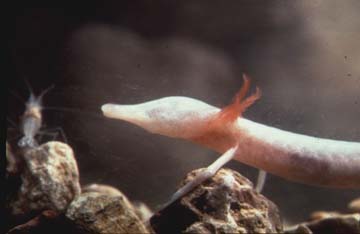
Exotic Discovery: Texas Blind Salamander


Posted by C. Allen Thompson
Telophase II member.


If you want to talk about one of nature's most beautiful species, I can't think of one that pops out at me more than this beautiful creature.  Unfortunately, there are very few left in the wild.  In fact, their numbers have dwindled to under 1,150 left on earth.

The Texas Blind Salamander (Eurycea rathbuni) is a cave-dwelling troglobite (obviously, since it's blind and all) amphibian found only in the Edwards aquifer of San Antonio, Texas.  Its full nomenclature is Animalia Chordata Amphibia Caudata Plethodontidae Eurycea Rathbuni.

It's not a picky eater at all.  The Salamander will eat anything that wanders into its cave that's small enough to kill and eat - they've been known to eat blind shrimp and malacostracan crustaceans

The Texas Blind Salamander is extremely threatened, although, its classification doesn't seem very dire according to the IUCN 3.1, which ranks this creature at a mere VU, just one step up from endangered.  As I said before, there are less than 1,150 of them left, though they only populate a small region.  The species is threatened because of toxic dumping, development, and a increasingly scarce water supply, according to IUCN.

If things continue on their path, there could be none of them left by the year 2023.  Yes, extinction happens all the time, but when we're directly responsible for the extinction, it's our duty to reverse the process and help the creature.  Let us remember that every ecosystem is essential for our global climate, because every ecosystem depends upon another to survive.  Conserve water, keep a close eye on housing developments and where they land, and report toxic dumping and vote on legislation to increase fines on dumping detrimental to human and animal health.  If we all work together, we can accomplish the world (literally).

Climate disasters: unlikely to be agents of progressive change from www.grist.org

avatar for David Roberts
by David Roberts
 
"Americans won't wake up and get serious about climate change until there's a disaster." I've been hearing people say that for years, but more and more lately. There's always an uptick after a political defeat like the failure of the climate bill.

It's delivered with "more in sadness than in anger" earnestness, and of course no one will ever say they want a disaster to happen, but it's hard not to detect, beneath the surface, some small bit of relish at the thought of saying "I told you so." In more heated circles, there's even a touch of Old Testament justice in the mix, as though Americans are getting what they deserve for their sinful ways and need to learn a lesson.

I think that's a dangerous temptation that should be strenuously avoided. First and foremost, disasters suck: They impose a great deal of suffering on innocent people. It is never a good thing when that happens. But even if the moral reason is set aside, there are still two practical reasons to doubt that disasters will prompt the kind of change climate hawks would want.

First, the U.S. has an almost $15 trillion economy. No sudden disaster this side of a massive nuclear attack could produce enough economic damage to substantially change the inertia of an economy that size. We've had disasters, including Hurricane Katrina and the Gulf BP oil spill, and while they've been tragic on their own terms, there wasn't enough cost to the national economy to force policymakers to large-scale or long-term action. Disasters do not tend to Change Everything. Hell, even the ongoing Great Recession produced only modest reforms, and its economic impact dwarfed that of any single natural disaster.

Some disasters have enormous second-order effects, by galvanizing the public and policymakers with such trauma that it leaves an enormous wake of social and political changes. Those disasters generally have something in common: They are caused by outsiders with human faces, like 9/11. It is in part the anger and thirst for revenge that give that kind of disaster its power to reshape the country. Natural disasters are seen as sad but not as creating an obligation for broad national action. Even "accidents" like the Gulf oil spill and the economic crash don't leave much behind these days (except tarballs).

The second reason is, even if there were one truly huge weather disaster, or a series of mid-level disasters in close succession, or something of similarly catastrophic impact, there's no guarantee that our collective response would be benign, or move us closer to smart policy. People don't tend to respond to trauma with good will and foresight. They respond with their amygdala: their fight-or-flight, us-or-them, zero-sum reptile brain. They become more susceptible to demagoguery, nationalism, and xenophobia, not less. I'm not sure a battered and fearful American public is one we can expect to embrace progressive change.

Anyway. I'm not trying to accuse anyone of wanting a disaster, of course. I just think we should extremely suspicious of the wistful hope that a disaster could do our social and political work for us. It's just as likely that the expected increase in severe weather events could, like so many other trends, make climate change more difficult to solve over time.

David Roberts is staff writer for Grist. You can follow his Twitter feed at twitter.com/drgrist.
disaster headlines
Disasters ain't gonna do it.

Cholera Anyone?


C. Allen Thompson
Telophase II Member
C. Allen Thompson is a freelance writer, radio personality, musician, blogger, and fellow professional heretic from Minneapolis, MN.  He is a graduate of the University of Minnesota and Medical Institute of Minnesota (Argosy University) with degrees in Sociology, Psychology, and Evolutionary Biology.  He is the author of Crusade: The Unchecked and Unbalanced Role of Faith in America, which is available in paperback at Amazon.com and is available for Nook, Nook Color, Nook for iPhone, Nook for PC, Nook for Android, and more, at barnesandnoble.com

CHOLERA ANYONE?
In my early years, I had a fetish with studying infections, namely those that have made an indelible mark in the history books of our young species.  Cholera is one of those, and is, in fact, still making its rounds.  In 2004, an outbreak of Cholera in India killed hundreds, but was almost nothing compared to the outbreak in Haiti in 2010.  In 2011, however, Cholera has made a reappearance on the shores of the US.  It has just been announced, in fact, by the USFDA, that at least 11 people in Louisiana have been diagnosed with the infection, and the cause seems to be (as expected) seafood from the Gulf of Mexico.

Not surprising, really, that in this day and age, Cholera can easily be treated, with its mortality rate being far less than 1% of caught in time.  However, Cholera left untreated has a much higher mortality rate, in the area of 50-60%.  All the more reasons for natural and raw food eaters like myself to stay scarce of seafood from the gulf for a while, or at least it's reason enough to cook our oysters and mussels no matter their origin.


What is Cholera, exactly?
Cholera is an infection of the small intestine that is brought on by Vibrio (gamma subdivision of the Proetobacteria) cholerae, which is a gram negative, comma shaped bacterium.  Obviously, the infection can occur after exposure to contaminated drinking water or food.  It has been known to cause both electrolyte imbalance as well as rapid dehydration from the often painful diarrhea and vomiting brought on by the infection (isn't science fun?).

Thus far, the reported cases are few, but it certainly gives us more than enough reasons to be very aware of the origin of our foods, as well as reason to make sure we're properly cooking what we eat.  Those of us outside the area obviously have no reason to start boiling our water and living off of Spam quite yet, but if the outbreak continues, it is sure to spread very quickly.